Earth Day is April 22, 2019, and to celebrate, we are sharing some environmental highlights from our businesses. Air, land, and water are areas where the JDI team works every day to reduce our environmental footprint. Below are some of the efforts and results:
Since 1990, our Pulp and Paper operations have reduced their carbon footprint by 55%. This puts us amongst top performers in North America and exceeds the target set by the Government of Canada and the Paris Climate Change Accord.
Today renewable green energy sources account for 59% of the fuel used at our pulp, paper, and tissue mills as well as our sawmills.
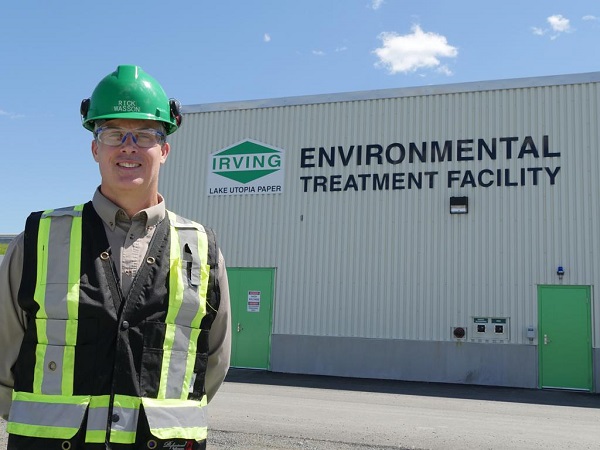
A recent $30 million investment at Lake Utopia Paper near St. George, N.B. earned the team the 2019 Industry Excellence Award from Natural Resources magazine. Natural Resources magazine’s 2019 Industry Excellence Award in Environmental Stewardship. The new environmental treatment facility turns organic waste into clean-burning biogas. This green energy replaces the use of fossil fuels, reducing greenhouse gas emissions by 25%. Check out the video here:
This year we will plant over 16 million trees – Nature’s air filters. Over the next 50 years growing trees on the lands we manage will absorb over 92 million tonnes of carbon dioxide. That’s equal to 350,000 cars off the road each year for the next 50 years.
NBM Railways have achieved a 31.4% improvement in fuel efficiency (2015-2018) – reducing fossil fuel consumption by over 13 million liters.
The national forest certification system of Belarus has successfully achieved PEFC re-endorsement, confirming it continues to meet our globally recognized Sustainability Benchmarks. This re-endorsement also ensures that certified forest owners and companies in Belarus continue to benefit from the global acceptance of PEFC. The Republican Association of Forest Certification System, PEFC’s National member for Belarus, first achieved endorsement of its national system in 2010. Since then, almost nine million hectares of Belarusian forests have been PEFC-certified – equating to virtually all of the country’s forest area. Click Read More below for additional information.
The forest industry is currently mobilizing for a unique project to promote a more low-impact approach to forestry. Komatsu Forest, SCA and the entire forest industry will collaborate to investigate the possibility of developing a low-impact machine, the benefits of which would include less driving damage in the forest. The project involves developing a new generation of forestry machines for more sustainable and low-impact forestry. The idea is to develop a machine that, with low ground pressure, causes less driving damage in the forest and improved driver comfort, at the same time as productivity can increase and there is a more even flow of timber for industry over the year. The participants in the project are: SCA, Holmen, Sveaskog, Norra Skogsägarna, Södra, Mellanskog, Norrskog, Bergvik, Stora Enso, Billerud Korsnäs and Komatsu Forest. Click read more below for additional detail.
If the people who depend on forests for their livelihoods aren’t included in conversations about sustainable forest management, how can it be truly sustainable? After all, people and forests are closely linked. Forests contribute to the livelihoods of some 1.6 billion people worldwide, the majority of which are in rural regions of developing countries. This means sustainable forest management and certification have the potential to positively impact a huge number of lives around the world. This subject is at the heart of both PEFC and Building and Wood Worker’s International (BWI). Earlier this month, our CEO Ben Gunneberg and Coen van der Veer from BWI came together to talk about this vital issue. Check out their conversation in the video below: