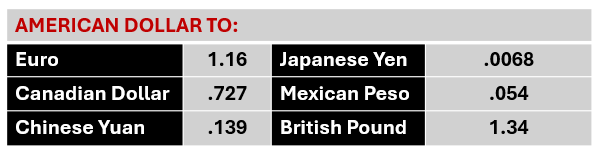
Key Currency Exchange Rates
Related Posts
ATA Chairman highlights trucking’s essential role throughout COVID-19
Randy Guillot, chairman of the American Trucking Associations and president of Triple G Express and Southeastern Motor Freight out of Jefferson, Louisiana, testified before the Senate Commerce Committee on the U.S. trucking industry’s response to the COVID-19 crisis—and on the role trucking will play in leading our economic recovery. Due to the U.S. Senate’s social distancing protocols, Guillot testified remotely via video conference from his home state of Louisiana. From his opening remarks: “Since the onset of the COVID-19 pandemic, the trucking industry has been thrust to the forefront of our national consciousness. While most activity ground to a halt across the country, America’s 3.5 million professional truck drivers kept moving. These heroes continue serving on the frontlines, ensuring everyone has the goods they need to get through these challenging times. “We hear the term ‘essential’ more frequently of late—as America wakes up to the gravity of what essential truly means. Truckers are the difference between a fully-stocked grocery store and one lined with empty shelves. They’re why doctors and nurses have PPE to protect themselves. They’re how test kits get to hot-spots for local officials to use to fight the virus’ spread.”
SCA continues with geofencing
Digital speed limitation for timber trucks works well on stretches with a lot of infrastructure, and haulage companies show great commitment to safer timber transports. This is demonstrated by the geofencing project that SCA has undertaken in collaboration with the Swedish Transport Administration. "We continue to utilize the technology on both existing routes and new ones," says Lars Nolander, logistics manager at SCA Skog. SCA's efforts to create safer timber transports have been ongoing for several years, and the latest initiative involves testing digital speed limitation, known as geofencing, on four selected routes in Västernorrland and Jämtland, where the road passes through villages or residential areas with houses and residents along the way. The technology involves creating zones using GPS points, where the vehicle senses when it's time to adjust the speed. Four haulage companies and nearly 40 timber trucks have been involved in the project.
