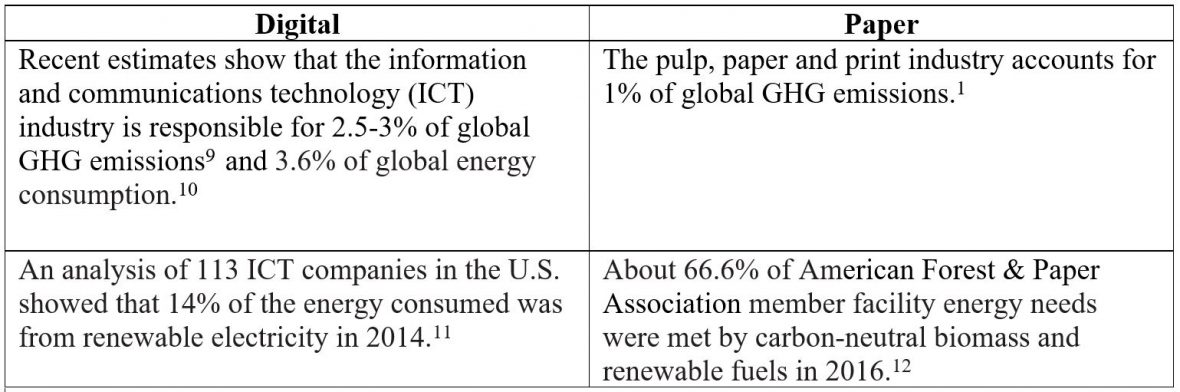
The pulp, paper and print industry is one of the lowest contributing industrial sectors to global greenhouse gas (GHG) emissions at only 1% of emissions worldwide,[1] but consumers don’t know it.
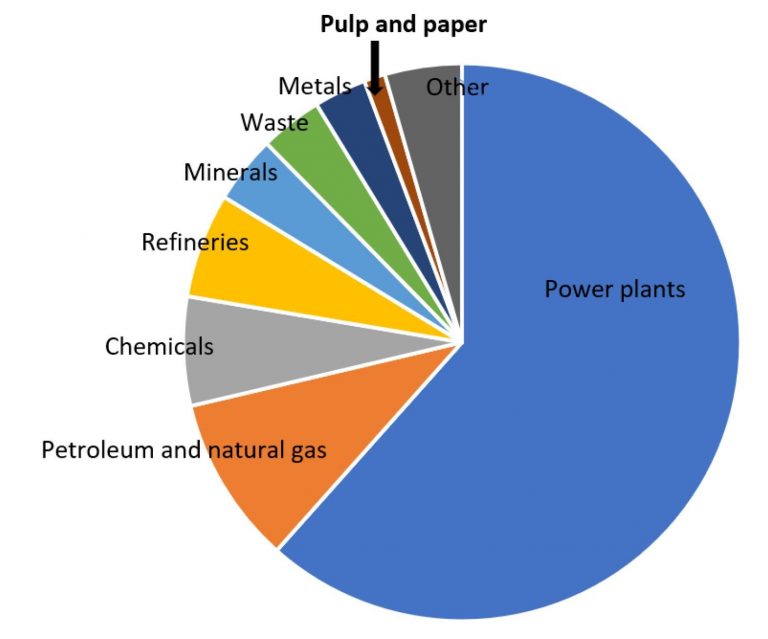
A recent consumer survey commissioned by Two Sides showed a disconnect between consumer perceptions and the facts about the industry’s impact on global GHG emissions.[2] The survey showed that 29% of Americans believe that paper production is a major contributor to global GHG emissions. However, the U.S. pulp and paper sector is one of the lowest emitters of GHG emissions among major U.S. industrial sectors at 1.2% of total U.S. industrial GHG emissions (Figure 1).[3]
Figure 1: U.S. industrial greenhouse gas emissions in 2017 (million metric tons of CO2e)(3)
One of the reasons for the relatively low GHG emissions of the forest products industry is its use of renewable fuels. For example, bioenergy use by paper and wood product mills in the U.S. prevents the emission of 181 million metric tons of CO2 equivalents, by merely using waste wood from manufacturing operations. This practice produces the same reduction in GHG emissions as removing about 35 million cars from the road.[4]
In Canada, the forest products industry has made great strides to reduce GHG emissions in production, by cutting the use of coal and cutting oil use by over 90% since the year 2000.[5] In fact, 57% of the industry’s energy use in 2015 was generated by bioenergy.[6]
Forest products also play a key role in global carbon sequestration (absorption) and the mitigation of GHG emissions. As they grow, trees remove CO2 from the atmosphere and they release oxygen, allowing us to breathe and sustain life on the planet. By managing our forests sustainably for the long-term, we can ensure that they continue to provide economic, social and environmental benefits, including climate change mitigation. For example, forests in Canada removed 150-160 million tonnes of CO2e from the atmosphere annually (between 2005 and 2016).[7]
A recent scientific paper has shown that the regeneration of forests through sustainable practices in the paper industry may lead to more carbon sequestration. Globally, younger forests (those growing for less than 140 years) store 1.17-1.66 billion metric tons of carbon per year while old-growth forests sequester 950 million-1.11 billion metric tons.[8]
Forest products like paper continue storing carbon even as a finished product and beyond their life in the forest. It is only if paper is landfilled, burned or left to decay that it begins to release CO2 again. In 2016, forests and wood products in the U.S. captured and stored roughly 10% of all carbon dioxide equivalents emitted by the U.S.[17]
But then why do people assume that going digital is greener? The “hidden” life cycle of our massive electronic infra-structure may be one reason. The fact is that many of us don’t think much about what goes into the manufacture and operation of our computers, smartphones, the energy needed to operate server farms, store massive amounts of digital information, and send emails. It is significant, but largely out of sight and out of mind.
The digital revolution is having a growing impact globally. Let’s explore a few key facts.
The energy consumption required for digital technologies is increasing by 9% each year.[13] In fact, the share of digital technology in global GHG emissions could reach 8% by 2025, i.e. the current share of car emissions.[14] [15] [16]. This is roughly 8 times the current share of the pulp, paper and print industries.
The ICT industry and infrastructure still rely heavily on fossil fuels and although it seems harmless to send an email, the world’s emails generate close to 300 million tonnes of CO2, equivalent to the CO2 emissions of over 63 million cars.[17]
This growing environmental impact of “going digital” is not going unnoticed by consumers who were specifically asked to rank several materials and products based on how environmentally-friendly they are (Figure 2). Wood and paper ranked at the top and electronics and plastics at the bottom (i.e. having the most environmental impact).
Smurfit Kappa, a global leader in sustainable packaging, and the print and paper advocacy association, Two Sides, fully support the EU Packaging and Packaging Waste Regulation (PPWR) as part of Europe’s Green Deal objectives. The legislation faces a crucial moment at the EU Council of Environmental Ministers on 18 December. The Council will have to decide whether it supports the European Parliament in acknowledging that both reuse and recycling systems go hand in hand in the interest of a greener Europe. The European cardboard industry has had, for decades, the best recycling system of all packaging materials. Total corrugated cardboard production in the EU is more than 30 million tonnes per year out of which over 90 per cent is recycled. A cardboard box can be recycled up to 25 times making it the most recycled packaging material in Europe. And when it isn’t, it’s still 100% biodegradable which means it disappears in nature within four months unlike other non-recyclable materials.
UPM supports the academy program of Plant-for-the-Planet, a charitable foundation that wants to contribute to climate protection. The foundation plants trees and organises children academies to promote sustainable thinking and environmental awareness. "In the academies children educate each other as amabssadors for climate justice. They learn concretely how the climate crisis threatens their future and the lives of people worldwide and develop their own actions for their future in groups. Furthermore, they also practice their presentation skills as a core competence for school and everyday life," explains Lisa Kohn, Public Relations, Plant-for-the-Planet. Click read more below for additional detail.
Informed procurement choices can support sustainable forest management, help protect workers’ health and the rights of those who depend on forests. Increasingly, those involved in public sector and corporate purchasing are setting ambitious targets which aim to eliminate deforestation from their supply chains.
The ‘Sustainable Procurement Guide for Wood and Paper-based Products’ from the World Resources Institute (WRI) & World Business Council for Sustainable Development (WBCSD) is designed to help procurement professionals do just this, enabling them to make informed choices and gain a better understanding of the challenges involved in the development and implementation of procurement policies for paper, packaging and solid wood products.