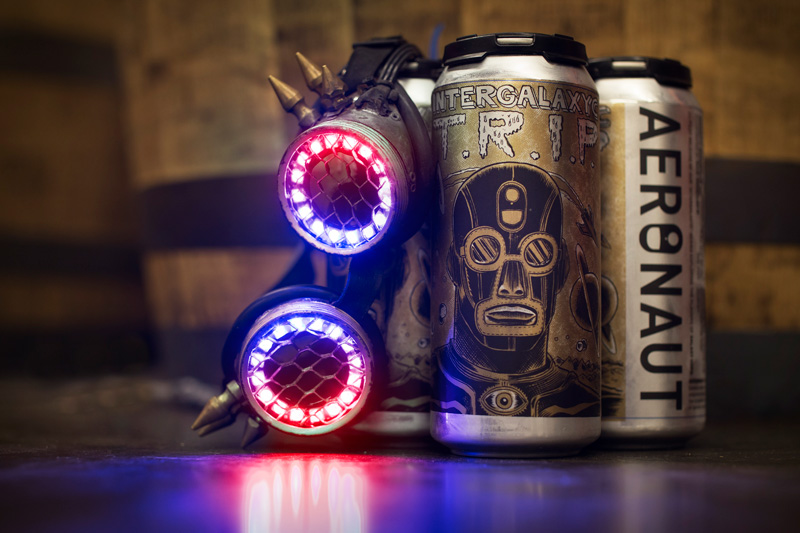
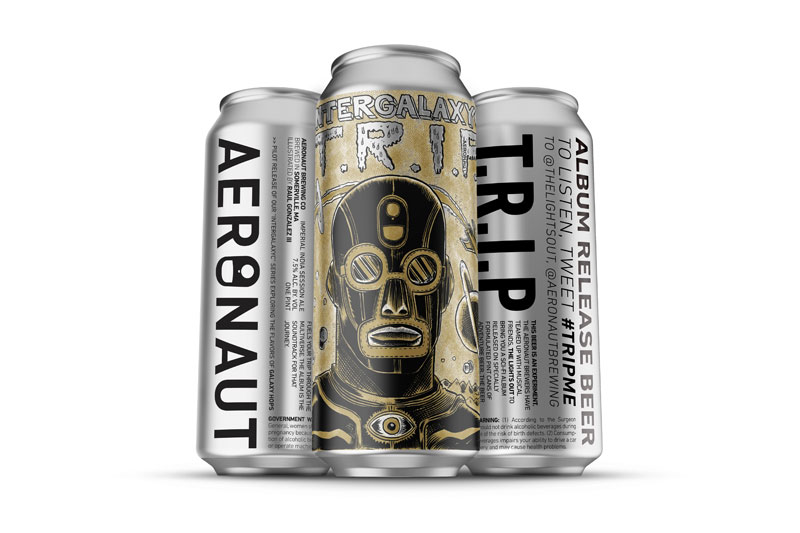
Imagine walking into the liquor store on a Friday night. You look past the brews you’ve already tried for something new. You spot a silver and gold capsule of a can, with a strange goggled figure on the label. The copy tells you this beer was formulated to fuel your journey through the multiverse, and it contains a sci-fi album as the soundtrack. To get the album, there’s a special hashtag. By tweeting it, you’ll receive a message telling you what you’re doing right now in a parallel reality, and a link to the music. Curiosity piqued, you bring it home, crack it open, take out your phone, and experience audio, visual, touch and taste in a single moment in time.
The T.R.I.P. album release beer is the first time a new studio album has ever been released on a beer can. The challenge that prompted the unique project was to figure out how to get people buying new music again, while helping a small indie band reach new fans. The solution: Pair the band with a brewery and turn the beer aisle into the next record store. The Lights Out wrote an album about traveling through parallel realities, and Aeronaut Brewing Co. developed a beer to pair with the songs. “A lot of the same people who once walked the music store aisles every weekend are now going to the beer store at least that often, with the aim of discovering something new. Most beer decisions happen in front of the cold case. The opportunity for someone to discover a band there caught our curiosity,” says Adam Ritchie, owner of Adam Ritchie Brand Direction and guitarist for The Lights Out.
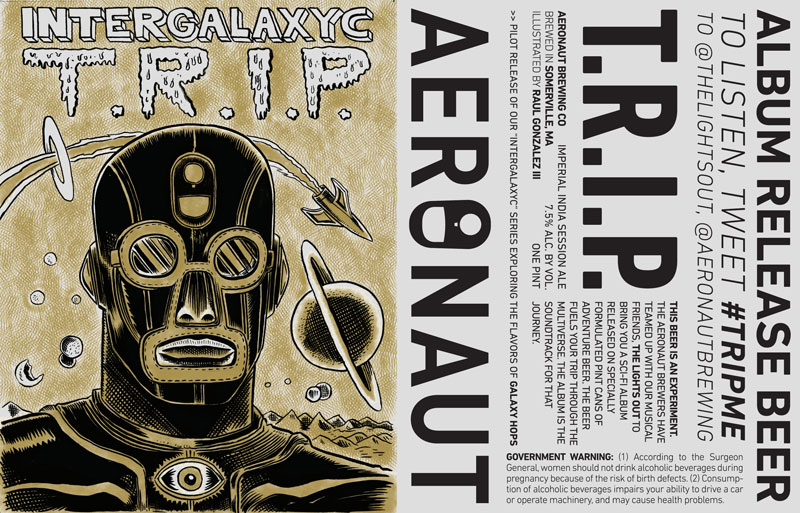
T.R.I.P. used design in a creative way to solve a decades-old music industry problem, give consumers a complete sensory experience with visual, touch and taste, and restore music fans’ physical relationship with new music. The campaign resulted in a new way for music to be discovered, generated international attention and caused the product to quickly sell out. “Adam’s team created a tremendous launch experience which completely transcended the ordinary and set a new standard for how these things should be done,” says Aeronaut Brewing Co. co-founder Ben Holmes. “It’s a game-changer that succeeded beyond our wildest expectations.”
Diversified Labeling Solutions is expanding its Auto ID product offering to include RAIN RFID labels. RFID (Radio Frequency Identification) labels utilize an embedded UHF inlay to transmit data via radio waves to an RFID encoder. They are used in a wide variety of industries including supply chain and distribution, retail, consumer goods and healthcare to increase speed and accuracy of data collection. RAIN RFID is a global alliance promoting the universal adoption of UHF RFID technology. DLS has long been a leading supplier of Auto ID labels, including traditional 1D and 2D barcodes. Adding RAIN RFID labels to their portfolio allows distributors to provide comprehensive Auto ID and smart label solutions to their customers. With access to a huge array of inlays and face sheet materials, DLS can support almost any RFID label construction for stock or custom-printed RFID labels. DLS will also serve as the genuine OEM supplier for TSC Printronix Auto ID labels.
Aptar Food + Beverage leveraged the benefits of two high-performance products, PolkaLite, a lighter version of the Polka closure (-1.3g), and the award-winning SimpliCycle recyclable valve to bring to manufacturers and consumers the highest levels of performance, convenience and sustainability in a closure that is reliable throughout the product life cycle. PolkaLite is a recyclable closure designed to use less raw materials. It not only helps brands in complying with packaging regulations and potentially achieve eco-taxes reduction, but it also appeals to environmentally conscious consumers who are committed to using products that are recyclable. PolkaLite, when paired with SimpliCycle, is a dispensing solution that is recyclable at the end of use, without compromising on performance. SimpliCycle, recently awarded the Best CSR/Sustainability Initiative at the World Food Innovation Awards ceremony in March 2021, is easily separated from the PET recycling stream and has the ability of being recycled with both PE and PP.
Net sales in the third quarter of 2020 were $1.6 billion compared to $1.7 billion in the prior year as net sales declined $76 million attributed to the divestment of ANZ. After adjusting for the sale of ANZ, average selling prices improved nearly 1 percent and increased revenue $12 million. Shipments increased 1.7 percent in tons, or $24 million, while unfavorable foreign currency translation reduced net sales by $11 million. Segment operating profit1 was $204 million in the third quarter of 2020 compared to $206 million in the prior year. Higher shipments benefited segment operating profit by $10 million. Cost inflation, which was elevated due to foreign currency pressures, more than offset the benefit of higher selling prices by $4 million. Operating costs were $6 million higher than the prior year as improved operating performance and cost control efforts substantially offset the impact of lower production levels. Current year profits were unfavorably impacted by the net effect of favorable foreign currency translation and the sale of ANZ.