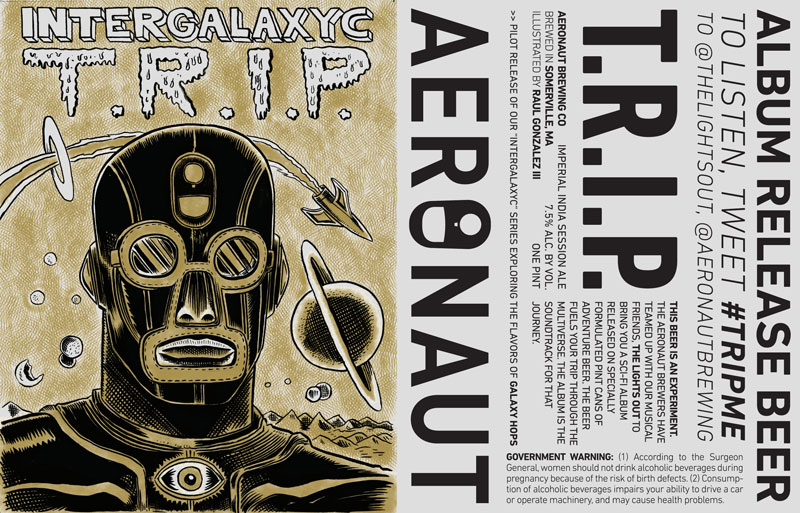
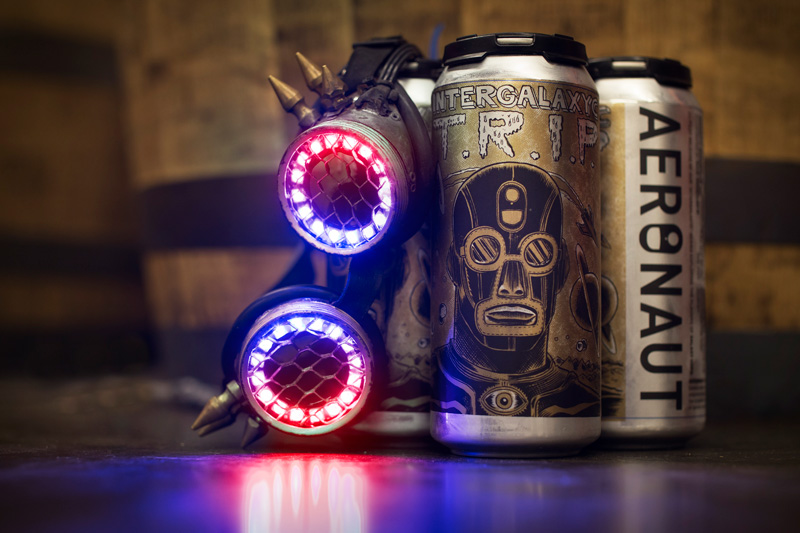
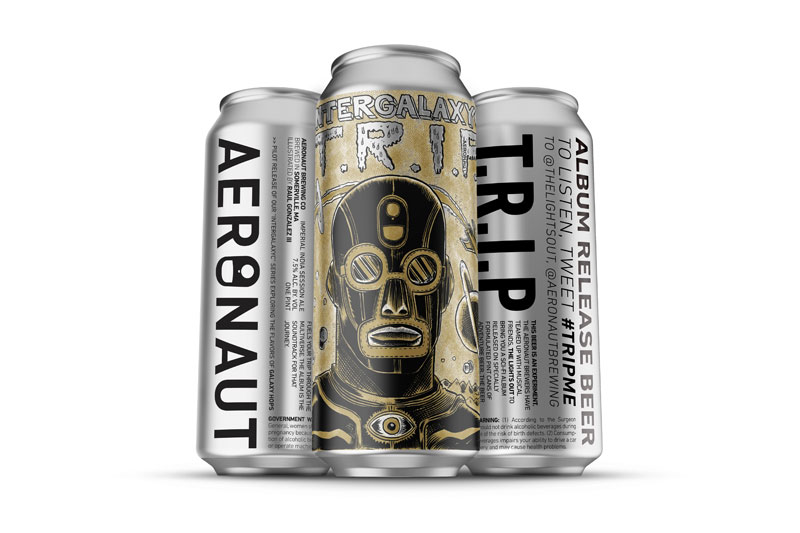
Imagine walking into the liquor store on a Friday night. You look past the brews you’ve already tried for something new. You spot a silver and gold capsule of a can, with a strange goggled figure on the label. The copy tells you this beer was formulated to fuel your journey through the multiverse, and it contains a sci-fi album as the soundtrack. To get the album, there’s a special hashtag. By tweeting it, you’ll receive a message telling you what you’re doing right now in a parallel reality, and a link to the music. Curiosity piqued, you bring it home, crack it open, take out your phone, and experience audio, visual, touch and taste in a single moment in time.
The T.R.I.P. album release beer is the first time a new studio album has ever been released on a beer can. The challenge that prompted the unique project was to figure out how to get people buying new music again, while helping a small indie band reach new fans. The solution: Pair the band with a brewery and turn the beer aisle into the next record store. The Lights Out wrote an album about traveling through parallel realities, and Aeronaut Brewing Co. developed a beer to pair with the songs. “A lot of the same people who once walked the music store aisles every weekend are now going to the beer store at least that often, with the aim of discovering something new. Most beer decisions happen in front of the cold case. The opportunity for someone to discover a band there caught our curiosity,” says Adam Ritchie, owner of Adam Ritchie Brand Direction and guitarist for The Lights Out.
T.R.I.P. used design in a creative way to solve a decades-old music industry problem, give consumers a complete sensory experience with visual, touch and taste, and restore music fans’ physical relationship with new music. The campaign resulted in a new way for music to be discovered, generated international attention and caused the product to quickly sell out. “Adam’s team created a tremendous launch experience which completely transcended the ordinary and set a new standard for how these things should be done,” says Aeronaut Brewing Co. co-founder Ben Holmes. “It’s a game-changer that succeeded beyond our wildest expectations.”
Amcor announced Web-Based Intelligent Packaging Evaluation (WIPE) as the winning student and faculty team of the latest Amcor Lift-Off pitch competition, hosted in partnership with Michigan State University (MSU). WIPE competed for an investment and collaboration opportunity as part of Amcor’s Lift-Off program, an open-call initiative aimed at supporting early-stage start-ups focused on innovative packaging solutions and related technologies. WIPE, developed by the research group of Dr. Euihark Lee at MSU’s School of Packaging, is an AI-based digital tool designed to leverage information mined from online customer reviews to assess the journey of a package throughout the distribution process. Once collected, the data is categorized for sentiment and key metrics, providing analysis that helps manufacturers identify critical issues during distribution and the consumer experience.
Sonoco announced tit has partnered with AMP Robotics, a pioneer in AI, robotics and infrastructure for the waste and recycling industry, to create a new material category within AMP’s neural network specific to rigid paperboard cans. The U.S. partnership will result in increased recycling rates for the spiral wound paper canister with steel bottom produced by Sonoco and other manufacturers. The use of recycled steel has a 45% lower environmental impact than producing the equivalent amount from virgin material, reducing the need to mine for virgin iron ore. Additionally, when compared to landfilling, recycling the paper container with steel bottom through the steel or other streams has a greater than 40% lower environmental impact than landfilling. Any materials recovery facility with an AMP Cortex™ intelligent robotics system can now accurately and efficiently sort Sonoco’s paper can to the desired stream.
Smurfit Kappa has invested USD23.5 million to upgrade its Nuevo Laredo sheet plant in Mexico to become a fully integrated corrugated plant. The investment includes a state-of-the-art corrugator and extension of the building. The new machine, which began operating last week, will have the two-pronged benefits of reducing CO2 emissions by up to 40% and doubling production capacity. The Nuevo Laredo plant is located in the Tamaulipas region in Northeastern Mexico where Smurfit Kappa has strong partnerships in the industrial, electrical appliances and electronics sectors. The region represents 3.3% of the country’s GDP and is home to over 200 companies which manufacture products for the US. The increased capacity will streamline Smurfit Kappa’s operations in San Antonio, Texas where a fast-growing appetite for sustainable packaging is demanding larger production volumes.