Earth Day is April 22, 2019, and to celebrate, we are sharing some environmental highlights from our businesses. Air, land, and water are areas where the JDI team works every day to reduce our environmental footprint. Below are some of the efforts and results:
Since 1990, our Pulp and Paper operations have reduced their carbon footprint by 55%. This puts us amongst top performers in North America and exceeds the target set by the Government of Canada and the Paris Climate Change Accord.
Today renewable green energy sources account for 59% of the fuel used at our pulp, paper, and tissue mills as well as our sawmills.
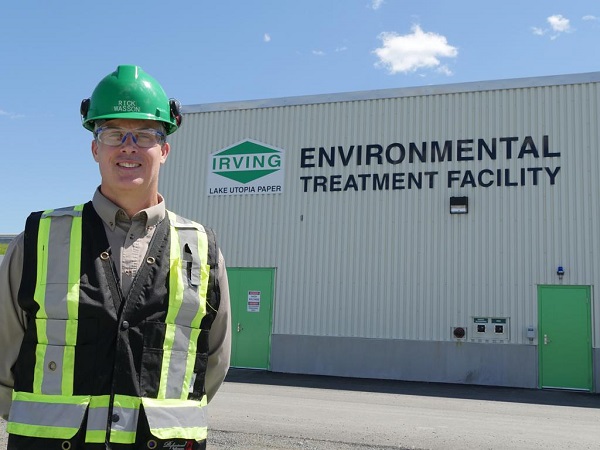
A recent $30 million investment at Lake Utopia Paper near St. George, N.B. earned the team the 2019 Industry Excellence Award from Natural Resources magazine. Natural Resources magazine’s 2019 Industry Excellence Award in Environmental Stewardship. The new environmental treatment facility turns organic waste into clean-burning biogas. This green energy replaces the use of fossil fuels, reducing greenhouse gas emissions by 25%. Check out the video here:
This year we will plant over 16 million trees – Nature’s air filters. Over the next 50 years growing trees on the lands we manage will absorb over 92 million tonnes of carbon dioxide. That’s equal to 350,000 cars off the road each year for the next 50 years.
NBM Railways have achieved a 31.4% improvement in fuel efficiency (2015-2018) – reducing fossil fuel consumption by over 13 million liters.
The public consultation, which is your chance to give your feedback on this revised system, will run from 3 July to 31 August 2023. PEFC Czech Republic revised the country’s national forest certification system following the entry into force of the revised 2018 PEFC Sustainable Forest Management standard. To provide you with additional information about this revised national system, we are holding a webinar on 3 July, at 10:00 CEST. The webinar is free to attend, and everyone is welcome. Register for the webinar at https://us02web.zoom.us/meeting/register/tZAqfuCuqzMtH9cvXBYvlPKQp0XKPk1lKRM2#/registration
The Spanish private research organisation CARTIF has completed the first assessment focusing on the environmental and social performance of Metsä Group’s Kuura textile fibre. Kuura is still in a R&D phase and the production process to make it is currently being tested and further developed at a tonne per day demo plant in Äänekoski, Finland. The outcome of the assessment conducted by CARTIF is very good for Kuura. In regard to environmental performance, when comparing to other commercial man-made cellulosic fibres (viscose and lyocell), and to cotton, Kuura shows the lowest impact on climate change, supporting its viability as a sustainable solution in the market of textile fibres (see Figure 1). More specifically, the use of local, sustainably managed wood raw material combined with the use of fully fossil free energy obtained from the existing industrial mill site and with a novel process for the production of Kuura textile fibre result in a product with a clear climate change mitigation potential compared to the use of existing commercial textile fibres.
The Navigator Company has once again been given an “A” rating by the CDP in a world survey assessing company action on climate change, achieved by only 3% of companies evaluated throughout the entire world. Navigator has been distinguished as a world leader in fighting climate change by the CDP, a non-governmental organization which evaluates the environmental performance of companies and cities, whose analyses are used by investors in their decision-making on sustainable investing.