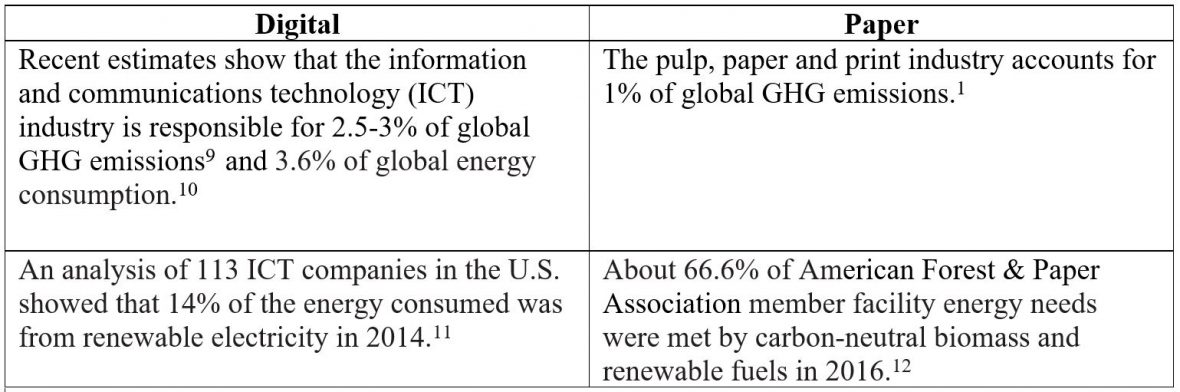
The pulp, paper and print industry is one of the lowest contributing industrial sectors to global greenhouse gas (GHG) emissions at only 1% of emissions worldwide,[1] but consumers don’t know it.
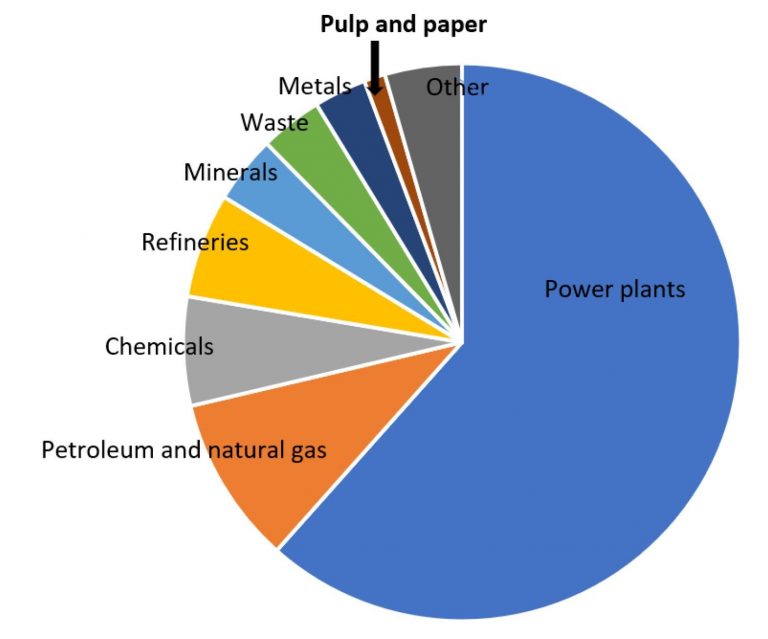
A recent consumer survey commissioned by Two Sides showed a disconnect between consumer perceptions and the facts about the industry’s impact on global GHG emissions.[2] The survey showed that 29% of Americans believe that paper production is a major contributor to global GHG emissions. However, the U.S. pulp and paper sector is one of the lowest emitters of GHG emissions among major U.S. industrial sectors at 1.2% of total U.S. industrial GHG emissions (Figure 1).[3]
Figure 1: U.S. industrial greenhouse gas emissions in 2017 (million metric tons of CO2e)(3)
One of the reasons for the relatively low GHG emissions of the forest products industry is its use of renewable fuels. For example, bioenergy use by paper and wood product mills in the U.S. prevents the emission of 181 million metric tons of CO2 equivalents, by merely using waste wood from manufacturing operations. This practice produces the same reduction in GHG emissions as removing about 35 million cars from the road.[4]
In Canada, the forest products industry has made great strides to reduce GHG emissions in production, by cutting the use of coal and cutting oil use by over 90% since the year 2000.[5] In fact, 57% of the industry’s energy use in 2015 was generated by bioenergy.[6]
Forest products also play a key role in global carbon sequestration (absorption) and the mitigation of GHG emissions. As they grow, trees remove CO2 from the atmosphere and they release oxygen, allowing us to breathe and sustain life on the planet. By managing our forests sustainably for the long-term, we can ensure that they continue to provide economic, social and environmental benefits, including climate change mitigation. For example, forests in Canada removed 150-160 million tonnes of CO2e from the atmosphere annually (between 2005 and 2016).[7]
A recent scientific paper has shown that the regeneration of forests through sustainable practices in the paper industry may lead to more carbon sequestration. Globally, younger forests (those growing for less than 140 years) store 1.17-1.66 billion metric tons of carbon per year while old-growth forests sequester 950 million-1.11 billion metric tons.[8]
Forest products like paper continue storing carbon even as a finished product and beyond their life in the forest. It is only if paper is landfilled, burned or left to decay that it begins to release CO2 again. In 2016, forests and wood products in the U.S. captured and stored roughly 10% of all carbon dioxide equivalents emitted by the U.S.[17]
But then why do people assume that going digital is greener? The “hidden” life cycle of our massive electronic infra-structure may be one reason. The fact is that many of us don’t think much about what goes into the manufacture and operation of our computers, smartphones, the energy needed to operate server farms, store massive amounts of digital information, and send emails. It is significant, but largely out of sight and out of mind.
The digital revolution is having a growing impact globally. Let’s explore a few key facts.
The energy consumption required for digital technologies is increasing by 9% each year.[13] In fact, the share of digital technology in global GHG emissions could reach 8% by 2025, i.e. the current share of car emissions.[14] [15] [16]. This is roughly 8 times the current share of the pulp, paper and print industries.
The ICT industry and infrastructure still rely heavily on fossil fuels and although it seems harmless to send an email, the world’s emails generate close to 300 million tonnes of CO2, equivalent to the CO2 emissions of over 63 million cars.[17]
This growing environmental impact of “going digital” is not going unnoticed by consumers who were specifically asked to rank several materials and products based on how environmentally-friendly they are (Figure 2). Wood and paper ranked at the top and electronics and plastics at the bottom (i.e. having the most environmental impact).
For the first time, more than 100 businesses in the packaging value chain, together with more than 50 other organisations, publicly recognise that without Extended Producer Responsibility (EPR) packaging collection and recycling is unlikely to be meaningfully scaled and tens of millions of tonnes of packaging will continue to end up in the environment every year. For a circular economy, packaging that can’t be eliminated or reused must be collected, sorted and recycled or composted after use. But currently the economics do not stack up: collection, sorting and recycling or processing packaging costs more than the revenues made from selling the recycled materials. We need dedicated, ongoing and sufficient funding to make the economics of recycling work. This statement and the supporting position paper set out why mandatory, fee-based EPR is the only proven and likely way to provide this funding.
An industrial pavilion and a road section, both in the Aveiro region, are the first visible results at real scale of using waste generated in the pulp and paper industry in precast concrete structures and in bituminous mixtures for roads paving in Portugal. The challenge, which is both complex and ambitious, emerged as part of the paperChain European project and is already being put into practice in Ílhavo and Cacia: using waste from pulp production, such as lime ash, dregs and grits (granular waste) as secondary raw materials in the construction sector, integrating them in a circular economy logic. The paperChain project includes 20 partners from five EU countries committed to circularity boosting). In Portugal, the entities involved include the University of Aveiro, The Navigator Company, Spral, Megavia, RAIZ Research Institute and the Sustainable Habitat Cluster. Called "New niche markets for waste from the pulp and paper industry based on the circular economy", it is coordinated by the company Acciona Construction (Spain).
A new study shows that, contrary to widespread belief within the solar power industry, new kinds of solar cells and panels don’t necessarily have to last for 25 to 30 years in order to be economically viable in today’s market.